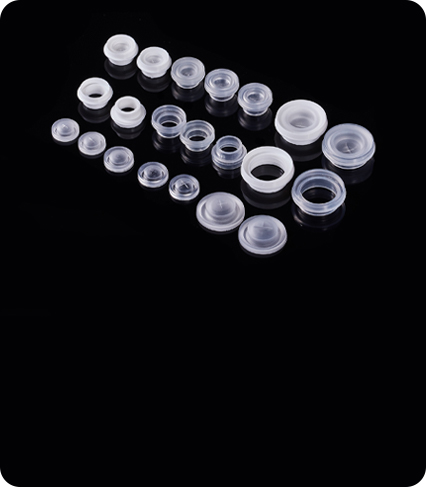
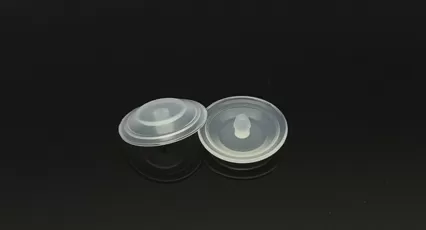
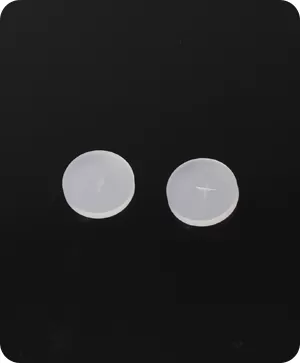
The hemostasis valve is one of the most technically demanding silicone valves used in medical devices. It is commonly applied in minimally invasive medical instruments where reliable sealing is critical to prevent blood leakage and backflow during surgical procedures.
At Hopewell, developing a medical-grade hemostatic valve had long been one of our engineering goals due to the high precision manufacturing requirements involved. Through continuous process development and validation, our engineering team successfully established a feasible production process and has already supported several customer projects in this field.

Unlike common cross slit silicone valves, the hemostasis valve requires a much more complex slit design.
The valve structure involves:
A straight slit cut from the front side
Another straight slit cut from the back side
The two slits intersect inside the center of the valve, forming an internal cross structure
However, each slit cannot cut completely through the material. Instead, the two partial slits must meet precisely inside the middle layer of the silicone component to form a sealed structure.
This design allows the valve to:
Maintain excellent sealing performance
Prevent blood backflow
Allow controlled instrument insertion when required
Achieving this structure requires extremely precise slit depth control and positioning accuracy.
The most challenging step in manufacturing a hemostatic silicone valve is the secondary slit alignment.
For a typical cross slit valve, the process is relatively straightforward:
The valve is positioned once.
A cross-shaped blade punches the slit directly in a single step.
However, for the hemostasis valve, the process is significantly more complex:
The first straight slit is punched from one side.
The valve must then be flipped or repositioned.
The second slit must be punched from the opposite side.
The second slit must intersect exactly with the first slit at the internal center.
Even a slight positioning deviation may result in:
Poor sealing
Unstable valve opening
Potential leakage
Therefore, high-precision positioning during the second punching operation is critical.
The valve is manufactured using medical-grade liquid silicone rubber (LSR) that meets ISO 10993 biocompatibility requirements.
Key material characteristics include:
Excellent elasticity and recovery
Stable sealing performance
Biocompatibility for medical applications
Long-term durability under repeated deformation
Extensive material evaluation was conducted to ensure optimal elastic recovery and sealing reliability for medical use.
To achieve reliable production of the medical hemostasis valve, our engineering team carried out extensive process development and testing.
Key efforts included:
Repeated validation of different slit blade designs
Testing multiple precision punching tools
Evaluating various punching equipment configurations
Optimizing positioning fixtures for second-side alignment
After numerous engineering trials and process improvements, Hopewell successfully established a stable manufacturing process for this complex valve structure.
Today, Hopewell has already developed multiple hemostasis valve projects, and some have successfully entered mass production.
Because this valve is used in medical procedures, manufacturing requirements are extremely strict. The production process must ensure:
Consistent slit geometry
Reliable sealing performance
Stable product quality
Any defect in the valve could potentially affect patient safety, which is why precision manufacturing and strict quality control are essential.
Hopewell continues to invest in the development of high-precision medical silicone valves to support customers in the medical device industry.
Our capabilities include:
Custom silicone valve manufacturing
Medical-grade LSR injection molding
High-precision slit cutting technology
Strict tolerance control and quality inspection
If you are developing a sealing or leak-prevention silicone valve for medical devices, our engineering team would be happy to support your project.
Contact Hopewell to discuss your custom medical valve requirements.
If you have any questions about us, you can leave a message online or contact us!
 EN
EN